
Chess Smith and director Clare-Louise English transformed the personal pain behind I’m Dead To You (And That’s OK) into a bold and visually striking music video about isolation, self-worth, and moving forward. Set in the world of office politics, the video uses vibrant colours, choreography, and symbolic imagery to explore the experience of being excluded by people once considered friends. In this interview, they discuss the creative process, the meaning behind the video's key visual metaphors, and how the project helped redefine Chess’s identity as a solo artist.
WHAT INSPIRED THE EMOTIONAL MESSAGE BEHIND “I’M DEAD TO YOU (AND THAT’S OK)” AND HOW DID YOU TRANSLATE THAT FEELING INTO THE VISUALS OF THE MUSIC VIDEO?
Chess Smith:
Witnessing people that you’ve heavily invested your energy and love into acting like you never existed is a very hard pill to swallow, and it’s something I experienced myself a few years ago. I went through a terrible ordeal that was no fault of my own, and people I thought I could trust turned their backs on me overnight.
It was a horrible thing to go through, so I started using music as a kind of therapy to cope with it. The initial idea for this song was just a note in my phone saying “I’m dead to you.” It was a sad feeling, and I wanted to process it and turn it into something positive—to be okay with it and understand that actually, it’s okay. I’d rather have true, unbiased friends around me who don’t default to taking sides.
In these break-up situations, you truly learn who your real friends are. For me, these lyrics were about turning the bitterness on its head. So many people get stuck asking, “Why do they not talk to me anymore? What did I do wrong?” When actually, it’s their loss, not yours. Some people side with whoever offers the most benefit to them—they don’t care what’s right or wrong. And they are not the people you need in your life.
Clare-Louise English:
I think our main driver was the idea of Chess being isolated from the group by fake people, playing with that “mean girl” energy. And what better way to play that out than through office politics.
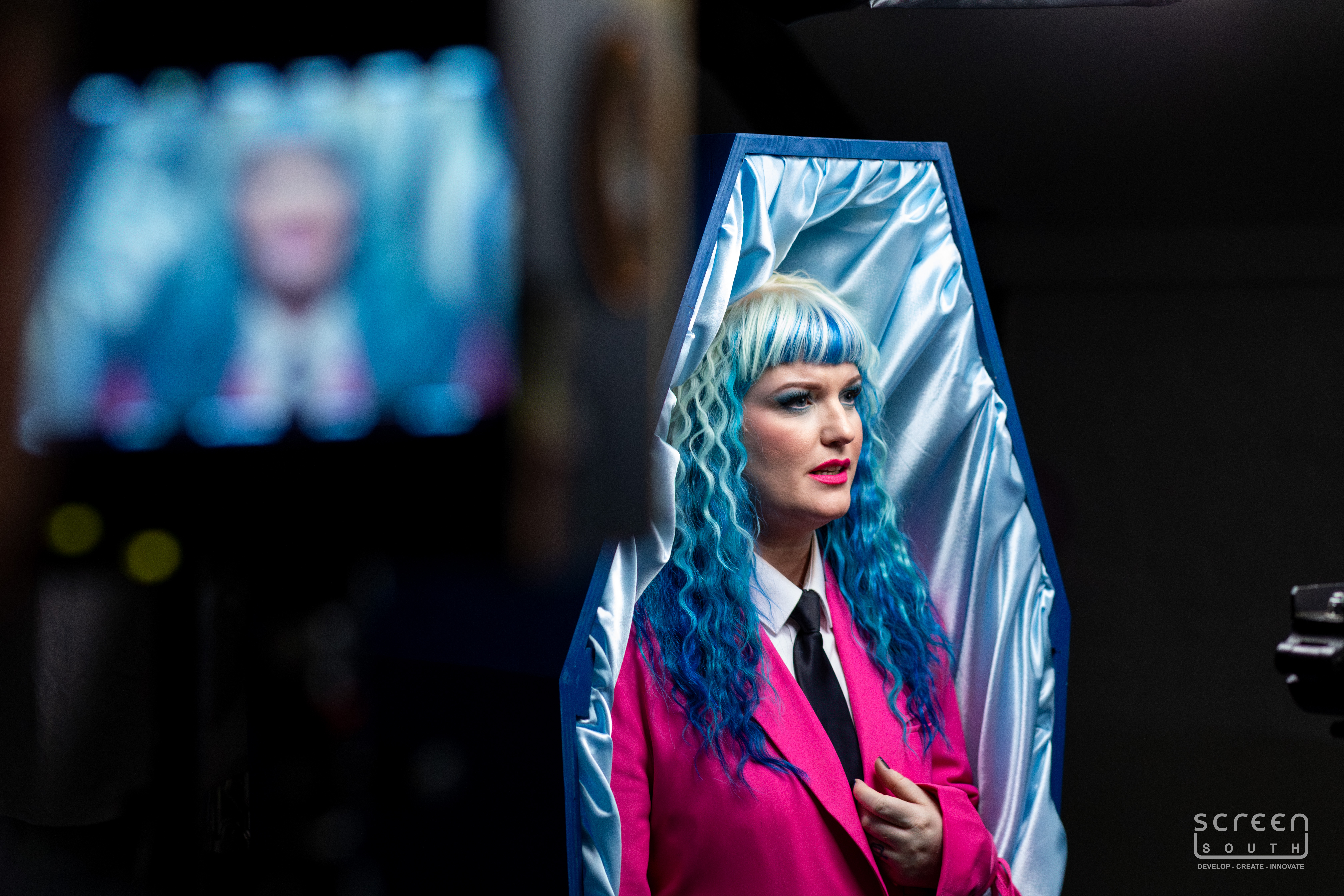
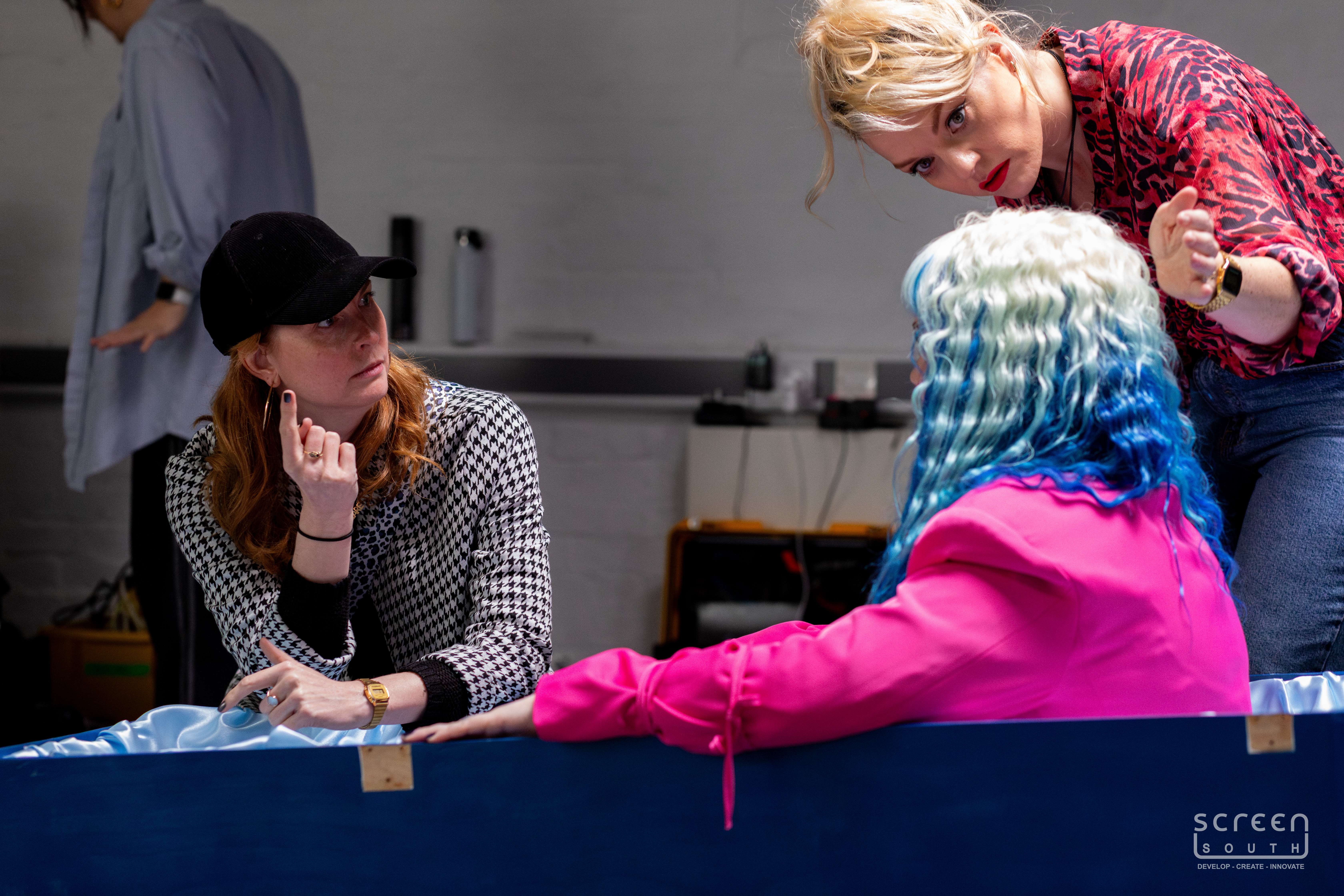
Chess brought the idea of the coffin and it being her safe space, so we originally planned for her to retreat back into it at the end. But I also liked the idea that she was being reborn from it, like a butterfly emerging from a chrysalis. We actually shot two different endings because right up until the edit I couldn’t decide which direction to take.
WHAT IS THE SYMBOLIC SIGNIFICANCE OF THE BUFFET FILLED ONLY WITH CAKE IN RELATION TO THE LYRIC “I DON’T WANNA BE YOUR CAKE”?
Chess Smith:
The reference to cake in the track symbolises people-pleasing and always being what everyone else wants you to be. Then there’s this turning point of realisation that you’ve been pleasing the wrong people, and enough is enough—they can’t have their cake and eat it this time.
Clare-Louise English:
I loved this idea. Once we’d decided to set the video at an office party, we knew there would be a buffet, and it just had to be cake and nothing else. It was a gift!
HOW DO THE SPECIFIC COLOUR CHOICES—BLUE AND GREY FOR THE OFFICE WORKERS VERSUS VIBRANT PINK FOR CHESS—VISUALISE HER ISOLATION AND TRANSFORMATION?
Clare-Louise English:
Once we chose the office setting, it was easy to push the blues and greys of both the location and the costumes worn by the other characters. We knew we wanted Chess to stand out and “pop” against those colours, so our designer suggested fluorescents, which worked brilliantly.
The pink specifically came from looking at the colours on Chess’s album cover and considering her personality, what suited her, and what would look amazing against her blue hair. We wanted the use of colour to feel playful, reflecting Chess’s personality and showing her as different from the other characters.
This was a great example of every department pulling in the same direction. Production design, make-up, and costume all played their part, and a massive shout-out goes to Willow Garms for the colour grade.
WHAT WAS THE MOST DIFFICULT SCENE TO SHOOT DURING PRODUCTION?
Clare-Louise English:
Oh my God, the slow-motion cake throwing! Thankfully, we planned to shoot it with Chess the night before the main shoot because we knew it would take time and make a huge mess.
It was also the most pressured scene because we only had a limited number of cakes to destroy. We wanted the cake to break apart as it flew through the air, but for some reason it stubbornly kept its shape until it hit the floor out of frame. In the end, we had to balance broken bits of cake together with tissue between the layers to stop them sticking, and Chess had to throw it before it fell apart in her hands.
Chess Smith:
It was also the longest I had to stand in heels, and I don’t do heels! I’m a platform or flat-shoe girl. I’m also a foot health practitioner by trade, so heels are usually a big no-no. I wore them for the three-hour shoot and definitely paid for it with pain. It was worth it though.
Clare-Louise English:
Oh God, sorry!
IN WHAT WAYS DOES THE CHOREOGRAPHY REPRESENT THE OFFICE WORKERS SHUNNING CHESS THROUGHOUT THE VIDEO?
Chess Smith:
They don’t acknowledge me at my own leaving party throughout the whole video, which really says it all!
Clare-Louise English:
We wanted them to dance around her without ever engaging with her, and I think that works really well.
CLARE-LOUISE, HOW DID YOUR BACKGROUND IN DANCE AND CHOREOGRAPHY INFLUENCE YOUR DIRECTORIAL CHOICES FOR YOUR FIRST MUSIC VIDEO?
Clare-Louise English:
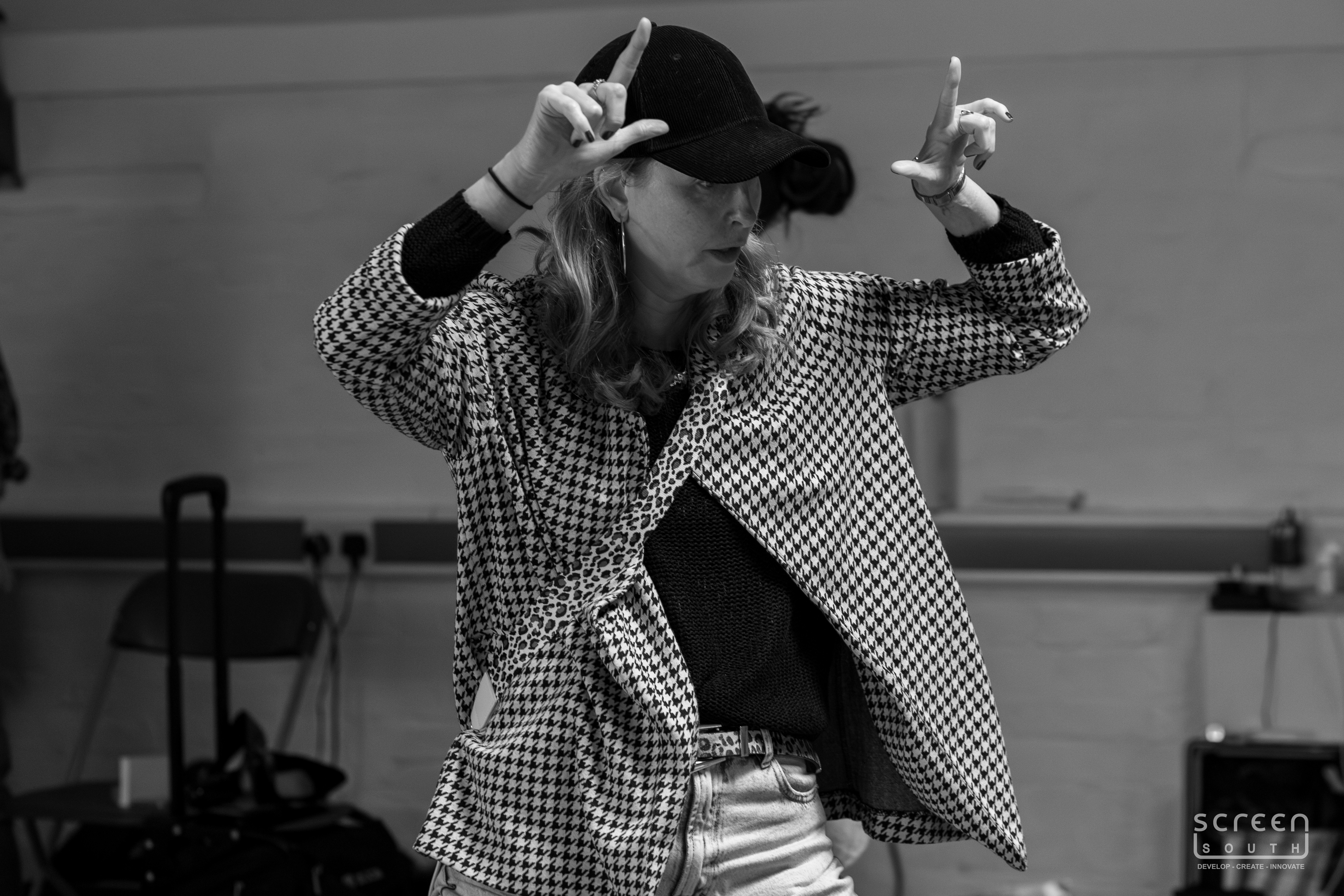
I come from a dance family—my mum and aunt both trained at the Royal Ballet School, and I also trained as a dancer. When I first heard Chess’s track, I immediately knew dance would be a great element to include.
I’ve been inspired by the wave of incredible dance music videos in recent years, such as “Somebody That I Used To Know” by CDK Company. We didn’t have the budget for something on that scale, but I’m incredibly proud of what we achieved.
Huge credit goes to Barbara Veg for choreographing the routines, to the dancers for getting covered in cake, and to my mum, who also appears as a dancer. It was special to bring those parts of my professional life together, and I hope I get to do it again.
AS A DEAF DIRECTOR, HOW DOES YOUR UNIQUE PERSPECTIVE OF STRADDLING BOTH THE DEAF AND HEARING WORLDS SHAPE YOUR VISUAL STORYTELLING?
Clare-Louise English:
It’s difficult to say because I’ve had a foot in both worlds for most of my life, but I do think it has made me a very visual storyteller.
When Hot Coals Productions first started, we made physical theatre without words. Everything was communicated through mime, masks, physical comedy, visual clues, and world-building through sets and props.
That experience—and filmmaking in general—has taught me how much story can be conveyed without a single spoken word. I love creating clearly defined worlds, and the office party is a great example. The setting is established quickly through visuals, and then you can start playing with audience expectations.
HOW DID YOU AND CHESS COLLABORATE TO BLEND HER PERSONAL EXPERIENCE OF A BREAKUP WITH THE WIDER THEME OF WOMEN’S CAREERS SUFFERING?
Clare-Louise English:
When Chess told me she had been pushed out of the band as a result of the breakup, it made me really angry. I often think about how many compromises women already have to make to build a career, so the inequality of the situation really struck a nerve.
That’s what inspired me to place the video in the recognisable world of an office. We wanted Chess to be ignored at her own leaving party, but with a positive undertone—she doesn’t belong there anymore because she’s moving on and redefining herself.
By the end, we wanted to flip the narrative: “I’m Dead To You” becomes “You’re Dead To Me.
Chess Smith:
My original idea involved being in a coffin—my safe place—then stepping out into a party where I’m ignored. I imagined throwing cake at everyone and ripping down a sign that said “All the Cake You Can Eat,” symbolising my people-pleasing tendencies.
Originally, I thought it was more about losing friends than being pushed out of my previous band, but subconsciously Clare helped me realise that it was all connected. The dancers and office concept transformed the whole thing into this incredible visual adventure of fun and chaos, organised perfectly by Clare and producer Jo Sargeant.
HOW CRUCIAL IS THE BALANCE BETWEEN NARRATIVE STORYTELLING AND ABSTRACT VISUAL METAPHORS IN MODERN MUSIC VIDEOS?
Clare-Louise English:
This was my first music video, and I come from a narrative background, so I loved the freedom of moving away from traditional storytelling and realism.
That said, I still like to create frameworks for myself. Once the world is clearly defined, you have a container in which you can make both logical and illogical creative decisions. Music videos are the perfect place to play with that balance.
Chess Smith:
I personally love a strong story combined with big visuals. The story encourages people to watch all the way through, while the visuals create that wow factor that makes them want to watch again and be inspired by what they see.
IN WHAT WAYS CAN A MUSIC VIDEO SUCCESSFULLY REDEFINE OR ELEVATE AN ARTIST’S BRAND DURING A TRANSITION FROM A BAND MEMBER TO A SOLO ARTIST?
Clare-Louise English:
I think it can have a huge impact. It’s an opportunity to redefine your style, image, personality, and the messages you want to put into the world.
It was important to me that Chess felt empowered in this video—that she looked comfortable in her own skin and unafraid to take up space. She’s incredibly talented and has such a playful spirit, and you can see that in her performance and the sparkle in her eye.
Chess Smith:
Moving from a rock band, where I could blend in with other members, to becoming a solo pop artist—while also becoming a mother—has been a huge step outside my comfort zone.
This music video has really helped me refine my branding and overall vibe, with the support of an amazing team. Since filming, I’ve barely stopped wearing blazers and shirts, and I’m collecting all kinds of weird and wonderful ties on Vinted. I’m feeling much more comfortable in my own skin.
Clare-Louise English:
I’m so happy to hear that.